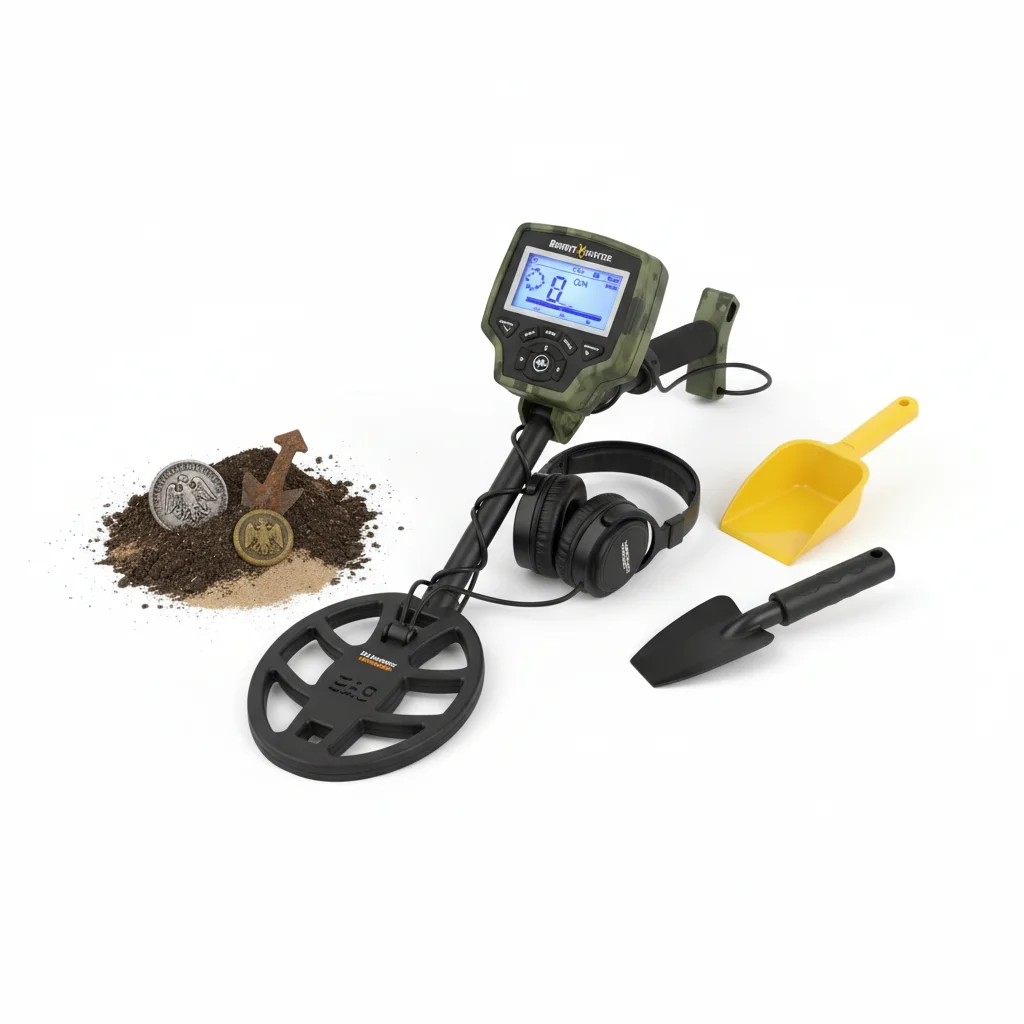
The Bounty Hunter Land Ranger Pro is the best Bounty Hunter metal detector for relic hunting, offering advanced features like a 0-99 target ID, adjustable ground balance, and multiple search modes. This model excels at distinguishing valuable historical artifacts from common trash, providing precise identification and depth capabilities essential for uncovering hidden treasures. It operates at 7.69 kHz and weighs 2.5 pounds, making it effective and comfortable for extended use.
Quick comparison
| Model | Target ID | Ground Balance | Frequency | Weight |
|---|---|---|---|---|
| Bounty Hunter Land Ranger Pro | Yes (0-99) | Adjustable | 7.69 kHz | 2.5 lbs |
| Bounty Hunter Discovery 3300 | Yes (4-tone) | Manual | 6.6 kHz | 2.5 lbs |
| Bounty Hunter Quick Draw Pro | Yes (9-segment) | Preset | 7.69 kHz | 2.3 lbs |
What Relic Hunting needs from a Metal Detector
Relic hunting demands specific features from a metal detector to ensure successful finds. Discrimination is paramount; a detector must effectively filter out junk like nails and pull tabs while accurately identifying valuable historical items such as coins, buttons, and tools. Adjustable ground balance is crucial for stable operation across varying soil conditions, from mineralized beaches to iron-rich fields, preventing false signals and improving target accuracy. Depth capability is another vital aspect, as many desirable relics are buried deeper than modern coins. A detector with good depth penetration increases the chances of uncovering older, more significant artifacts. Furthermore, a clear and precise target ID system, often numerical, helps hunters quickly assess the probable identity of a buried object before digging, saving time and effort. Lightweight design and ergonomic construction are also beneficial for long hours of searching in diverse terrains. The ability to pinpoint targets accurately reduces recovery time and minimizes damage to delicate relics. For more metal detecting guides on this site.
Detailed reviews
Bounty Hunter Land Ranger Pro
The Bounty Hunter Land Ranger Pro stands out as a top choice for relic hunters. Its 0-99 numerical target ID system provides excellent target identification, allowing users to differentiate between various metals with high accuracy. The adjustable ground balance feature is critical for maintaining stable performance in diverse soil conditions, from highly mineralized ground to wet sand, ensuring fewer false signals. Operating at 7.69 kHz, it offers a good balance of sensitivity to small targets and depth penetration for larger relics. The Land Ranger Pro includes multiple search modes, such as all-metal, discrimination, and notch, giving hunters flexibility in their search strategies. Its lightweight design, at just 2.5 pounds, makes it comfortable for extended use, a significant advantage during long relic hunting expeditions. The large LCD screen is easy to read, displaying target ID, depth indicator, and battery status clearly. This model is known for its robust construction and reliable performance in the field.
Bounty Hunter Discovery 3300
The Bounty Hunter Discovery 3300 offers a solid set of features for relic hunters on a budget. It includes a 4-tone audio ID system, which helps in distinguishing targets by sound, and a 10-segment visual target ID for more precise identification. The manual ground balance control, while not as advanced as automatic systems, allows users to fine-tune the detector for specific ground conditions, which is beneficial for reducing chatter in mineralized soil. Operating at 6.6 kHz, it provides decent depth and sensitivity for common relics. The Discovery 3300 features four search modes: all-metal, discrimination, notch, and auto-notch, offering versatility for different hunting scenarios. Weighing 2.5 pounds, it remains a comfortable option for prolonged use. Its intuitive interface makes it accessible for both beginners and intermediate relic hunters. While it may not have the extreme depth of higher-end models, its reliable performance and user-friendly design make it a strong contender for finding historical artifacts.
Bounty Hunter Quick Draw Pro
The Bounty Hunter Quick Draw Pro is an excellent entry-level option for relic hunters seeking simplicity and effectiveness. It features a 9-segment target ID system, providing visual cues for different types of metals, and a 3-tone audio ID for quick target assessment. The preset ground balance simplifies operation, making it ideal for beginners who prefer not to deal with manual adjustments. Operating at 7.69 kHz, it offers good sensitivity to small relics and decent depth for its price point. The Quick Draw Pro includes three search modes: all-metal, discrimination, and notch, allowing users to filter out unwanted junk. Its lightweight design, at 2.3 pounds, ensures comfortable handling during long searches. The large, easy-to-read LCD screen displays target ID, depth, and battery life. While it lacks some of the advanced features of more expensive models, its straightforward operation and reliable performance make it a capable tool for uncovering historical items, especially in areas with moderate mineralization.
Routine fit
A Bounty Hunter metal detector for relic hunting fits seamlessly into a routine focused on historical discovery. These detectors are designed for ease of use, allowing hunters to quickly set up and begin searching in various historical sites, from old homesteads to battlefields. Their lightweight construction ensures comfort during extended periods of sweeping, which is common when covering large areas. The intuitive controls mean less time spent on adjustments and more time actively searching for targets. Whether it’s a weekend excursion to an old town site or a dedicated search in a known historical area, a Bounty Hunter detector provides reliable performance. The clear target identification and discrimination features help streamline the process, reducing the amount of time spent digging up trash and increasing the focus on valuable relics. This efficiency makes them suitable for both casual hobbyists and more serious relic hunters.
FAQs
What is the best frequency for relic hunting?
For relic hunting, a frequency between 5 kHz and 15 kHz is generally considered optimal. Lower frequencies, around 5-8 kHz, are better for deeper penetration and larger, higher-conductive targets like brass buttons or large iron relics. Higher frequencies, around 10-15 kHz, offer better sensitivity to smaller, lower-conductive targets such as small silver coins or thin bronze artifacts. The Bounty Hunter Land Ranger Pro and Quick Draw Pro operate at 7.69 kHz, providing a good balance for a wide range of relics, while the Discovery 3300 at 6.6 kHz is also effective for general relic hunting.
How important is ground balance for relic hunting?
Ground balance is extremely important for relic hunting, especially in areas with varying soil mineralization. Mineralized ground can cause false signals and reduce detection depth. An adjustable ground balance feature allows the detector to ignore these ground minerals, focusing solely on buried metal targets. This results in more stable operation, fewer false signals, and improved detection depth and accuracy. Without proper ground balance, a detector can become noisy and ineffective, making it difficult to distinguish between actual relics and ground interference.
Can Bounty Hunter detectors find deep relics?
Bounty Hunter detectors, particularly models like the Land Ranger Pro, are capable of finding relics at respectable depths. While they may not match the extreme depth capabilities of some high-end, specialized detectors, they are well-suited for finding many common and historically significant relics buried within the top 6-12 inches, and sometimes deeper depending on target size and soil conditions. Factors like target size, metal type, ground mineralization, and coil size all influence the maximum detection depth. For typical relic hunting, Bounty Hunter models offer sufficient depth performance.
Are Bounty Hunter detectors good for beginners in relic hunting?
Yes, Bounty Hunter detectors are excellent for beginners in relic hunting. Many models, such as the Quick Draw Pro and Discovery 3300, are designed with user-friendly interfaces and straightforward controls. This makes them easy to learn and operate without requiring extensive technical knowledge. Their affordability also makes them an accessible entry point into the hobby. While they offer essential features for successful relic hunting, they don’t overwhelm new users with overly complex settings, allowing beginners to focus on learning the basics of target identification and recovery.
What accessories are essential for relic hunting with a Bounty Hunter detector?
Several accessories are essential for effective relic hunting. A good digging tool, such as a sturdy trowel or spade, is crucial for excavating targets. A pinpointer is highly recommended for quickly locating targets within the plug of dirt, minimizing recovery time and preventing damage to delicate relics. Headphones improve target audio clarity, allowing hunters to hear faint signals that might otherwise be missed. A finds pouch is useful for storing recovered items and keeping trash separate. Additionally, a coil cover protects the search coil from scratches and wear in rough terrain.
Verdict
For relic hunters seeking a reliable and effective tool, the Bounty Hunter Land Ranger Pro stands out as the best choice within the Bounty Hunter lineup. Its advanced target ID, adjustable ground balance, and multiple search modes provide the precision and versatility needed to uncover historical artifacts. While the Discovery 3300 and Quick Draw Pro offer excellent value for beginners and those on a budget, the Land Ranger Pro’s superior features make it more adept at handling diverse relic hunting scenarios. Investing in a Bounty Hunter detector ensures a rewarding try in the pursuit of historical treasures.
Frequently Asked Questions
What is the optimal frequency range for relic hunting with a metal detector?
For relic hunting, an optimal frequency range is generally between 5 kHz and 15 kHz. Frequencies around 5-8 kHz are better for deeper penetration and larger, higher-conductive targets, while 10-15 kHz offers better sensitivity to smaller, lower-conductive items. The Bounty Hunter Land Ranger Pro operates at 7.69 kHz, providing a balanced performance for various relics.
Why is ground balance important for successful relic hunting?
Ground balance is extremely important for relic hunting, especially in areas with varying soil mineralization. It allows the detector to ignore ground minerals that cause false signals, leading to more stable operation and improved detection depth and accuracy. Without proper ground balance, a detector can become noisy and ineffective, making it difficult to distinguish actual relics from interference.
Can Bounty Hunter metal detectors effectively find deep historical relics?
Bounty Hunter detectors, particularly models like the Land Ranger Pro, are capable of finding relics at respectable depths, often within the top 6-12 inches. While they may not match the extreme depth of some high-end specialized detectors, they are well-suited for many common and historically significant relics. Factors like target size, metal type, and soil conditions influence maximum detection depth.
Are Bounty Hunter metal detectors suitable for beginners interested in relic hunting?
Yes, Bounty Hunter detectors are excellent for beginners in relic hunting. Models such as the Quick Draw Pro and Discovery 3300 feature user-friendly interfaces and straightforward controls, making them easy to learn and operate. Their affordability also provides an accessible entry point into the hobby, allowing new users to focus on target identification and recovery without complex settings.
What essential accessories should a relic hunter use with a Bounty Hunter detector?
Several accessories are essential for effective relic hunting. A sturdy digging tool, such as a trowel or spade, is crucial for excavation. A pinpointer is highly recommended for quickly locating targets within the dirt plug, minimizing recovery time and preventing damage. Headphones improve audio clarity for faint signals, and a finds pouch is useful for storing recovered items and separating trash.
The Bounty Hunter Discovery 3300 has been a solid workhorse for my relic hunting trips. The 4-tone target ID is pretty good once you get used to it, and the manual ground balance is a must-have for my local spots. It’s lightweight enough for long days out, which is a huge plus.
I picked up the Bounty Hunter Quick Draw Pro for its light weight and decent price. It’s okay for general use, but I’ve found the preset ground balance a bit limiting in some of the more mineralized soil I hunt in. It’s good for beginners, but I might need something with more adjustability soon.
I finally upgraded to the Bounty Hunter Land Ranger Pro after years with a basic model, and wow, what a difference! The 0-99 target ID is a game-changer for me. I’m finding way more actual relics and spending less time digging up bottle caps. It’s really helped me pinpoint those valuable historical artifacts.
The Land Ranger Pro is fantastic! I was hesitant about the 7.69 kHz frequency, but it’s been incredibly effective at distinguishing between trash and treasure. The adjustable ground balance really helps me fine-tune it for different sites, and at 2.5 pounds, it’s comfortable for hours of searching. Highly recommend for serious relic hunters.