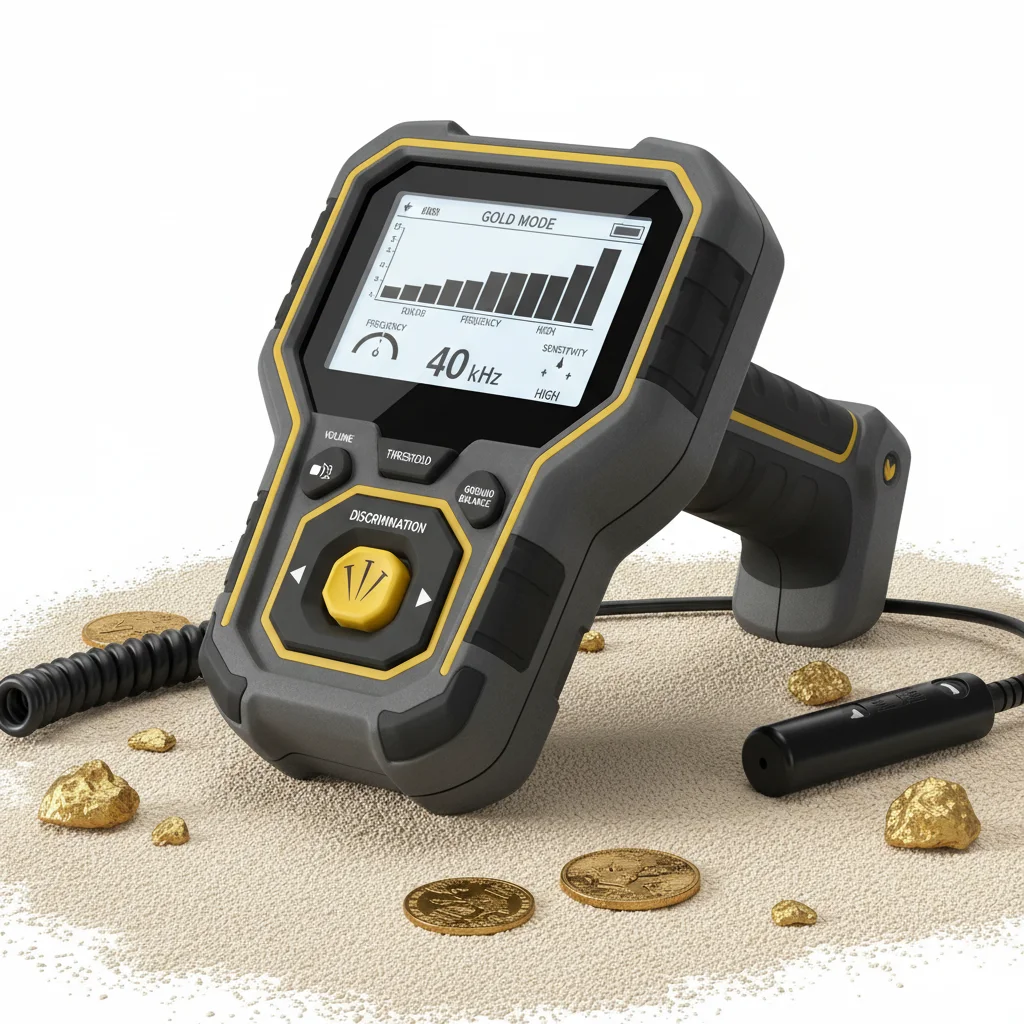
Optimizing your metal detector settings is crucial for successfully finding gold nuggets. The best approach involves using a high operating frequency, a sensitive discrimination setting, and a ground balance tailored to your specific hunting environment. These adjustments will help your detector pick up the subtle signals of gold while filtering out common ground mineralization and junk.
Understanding Frequency for Gold Detection
Gold nuggets, especially smaller ones, respond best to higher frequencies. Most entry-level detectors operate around 6-8 kHz, which is adequate for general relic hunting. However, for serious gold prospecting, look for detectors with frequencies of 18 kHz or higher. Some specialized gold detectors can even reach 40-70 kHz, offering extreme sensitivity to tiny gold specimens. Always check your detector’s manual to understand its frequency capabilities and how to adjust them.
Discrimination Settings for Gold
Discrimination allows your metal detector to ignore certain types of metal, such as iron or foil. While it’s tempting to discriminate heavily to avoid trash, gold often registers at similar conductivity levels to some junk metals. For gold prospecting, it’s generally recommended to run with very low discrimination, or even in all-metal mode, to ensure you don’t miss small gold pieces. If you must use discrimination, set it just above iron to filter out common ferrous junk, but be aware you might still dig some non-gold targets.
Ground Balance: A Critical Setting for Gold
Ground balance is perhaps the most critical setting for gold prospecting, as gold-bearing ground is often highly mineralized. Mineralization can cause false signals and mask genuine gold targets. There are typically two types of ground balance: manual and automatic. Manual ground balance allows you to precisely tune your detector to the specific ground conditions, which is often preferred by experienced prospectors. Automatic ground balance is simpler but may not be as accurate in highly variable ground. Always re-ground balance frequently as you move across different terrain.
- Use a high-frequency coil (18 kHz+) for maximum sensitivity to small gold.
- Operate in all-metal mode or with very low discrimination to avoid missing gold.
- Manually ground balance frequently to compensate for changing soil mineralization.
- Reduce sensitivity if experiencing excessive chatter or false signals in highly mineralized areas.
- Swing your coil slowly and deliberately to allow the detector to process signals effectively.
Sensitivity and Threshold Adjustments
|
Our Picks for the Best Metal Detector in 2026
As an Amazon Associate I earn from qualifying purchases.
|
||
| Num | Product | Action |
|---|---|---|
| 1 | DR.ÖTEK Metal Detector for Adults, Professional Metal Detectors Waterproof with 10" IP68 Coil, Larger LCD Display, High Accuracy for Gold & Silver Detection & Beach Treasure Hunting, Beginner Friendly |

|
| 2 | GoGonova Metal Detector for Adults & Kids, Kids Metal Detector, Waterproof Metal Detectors with High Accuracy Lightweight 8" Search Coil, All Metal & Disc Modes for Junior & Youth Gold Detector |
|
| 3 | Bounty Hunter TK4 Tracker IV Metal Detector – All-Terrain Gold, Silver, Coin & Relic Finder with 8" Waterproof Coil, 3 Detection Modes – for Adults & Kids – Made in USA |
|
| 4 | 2026 Latest Metal Detector for Adults, Professional Waterproof & Adjustable Stem, Higher Accuracy Gold Detector with LCD, Advanced DSP Chip, 2.26 Pounds Lightweight Suitable for Beach and Backyard |
|
| 5 | PANCKY Metal Detectors for Adults Waterproof, Professional Higher Accuracy Gold Detector with LCD Display, 5 Mode, Advanced DSP Chip 10" Coil, PK0075 |
|
| 6 | Professional Metal Detector for Adults,12" IP68 Waterproof Search Coil with LCD Backlight,5 Modes Gold Detector,Advanced DSP Chip&High Accuracy System for Beach/Gold Hunting |
|
| 7 | PANCKY Metal Detectors for Adults Waterproof, Professional Higher Accuracy Gold Detector with LCD Display, 5 Mode, Advanced DSP Chip 10" Coil, PK0075 |
|
| 8 | SUNPOW Metal Detector for Adults Professional - High Accuracy with 12" Waterproof Coil, 2x Backlit LCD Display, Advanced DSP Chip, 5 Modes, Adjustable Length (19"-59"), Sturdy Spiral Structure -OTMD14 |
|
| 9 | Metal Detector for Adults Professional, Waterproof Pinpoint, High Accuracy Gold and Silver Detection, Underwater and Beach Use, 10'' IP68 Coil, Bigger LCD, New Advanced DSP Chip, Black |
|
| 10 | SUNPOW Metal Detector for Adults & Kids, Kids Metal Detector kit Waterproof for Gold Detecting, Stable Anti-Interference, Higher Accuracy, Bigger LCD Display, 4 Modes, 8" Search Coil, MD13 |
|
Sensitivity controls how deep your detector can ‘see’ and how responsive it is to faint signals. For gold, you want to run your sensitivity as high as possible without getting excessive false signals or chatter. In highly mineralized ground, you may need to reduce sensitivity slightly to maintain stable operation. The threshold setting controls the continuous hum you hear in all-metal mode. For gold prospecting, set the threshold to a barely audible hum. This allows you to hear subtle breaks or increases in the hum, which can indicate a small or deep gold target.
Coil Selection for Gold Prospecting
The type and size of your search coil also play a significant role. Smaller coils (6-8 inches) are more sensitive to small gold nuggets and perform better in highly mineralized ground, making them ideal for pinpointing. Larger coils (10-15 inches) offer greater depth but are less sensitive to tiny gold and can struggle more in mineralized soil. Many gold prospectors use a smaller elliptical coil for general searching and a larger coil for covering more ground in less mineralized areas.Consider a specialized gold prospecting coil for your detector to enhance performance.
Practice and Patience
Even with the perfect settings, finding gold requires practice and patience. Spend time learning the sounds your detector makes for different targets and ground conditions. Dig all repeatable signals, especially when running with low discrimination. Gold signals can be faint and easily mistaken for junk. Research local geology and historical gold finds to increase your chances of success.Investing in a quality gold-specific metal detector can significantly improve your prospecting results.
