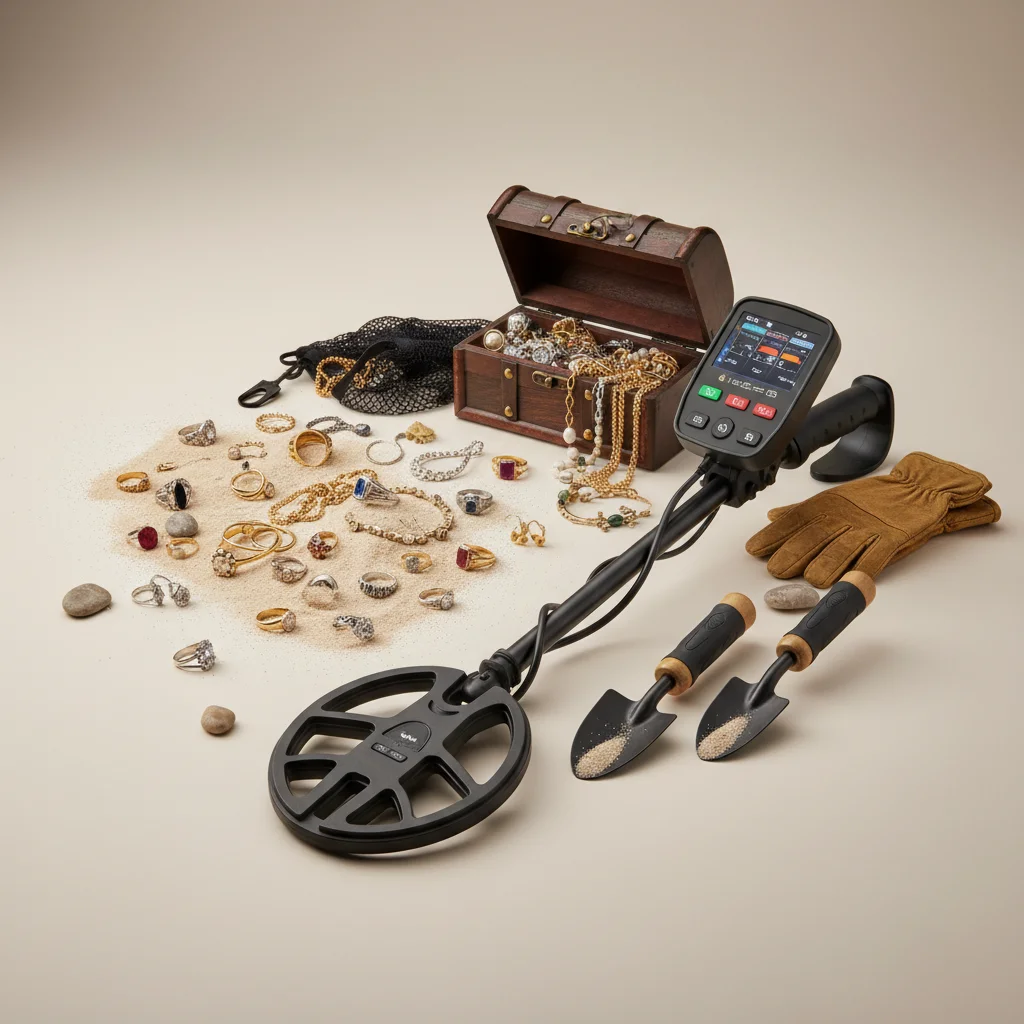
When metal detecting for jewelry, the optimal settings on your detector will significantly increase your chances of success. Generally, a frequency between 10-20 kHz is ideal for detecting various types of jewelry, from gold rings to silver pendants. This range offers a good balance between sensitivity to small, low-conductive targets like gold and the ability to penetrate deeper into the soil.
Understanding Frequency and Jewelry Detection
The operating frequency of your metal detector is crucial for jewelry hunting. Lower frequencies (below 10 kHz) are better for larger, deeper targets and highly conductive metals like silver, but may miss smaller gold items. Higher frequencies (above 20 kHz) are excellent for very small gold nuggets and fine chains, but can be more susceptible to ground mineralization and EMI, leading to false signals. For a general jewelry hunt, a mid-range frequency provides the best all-around performance. For explore our metal detecting reviews on this site.
Ground Balance for Stable Performance
Proper ground balancing is essential to minimize false signals caused by mineralized soil, which is common in many jewelry-rich areas like beaches and parks. Most modern detectors offer automatic or manual ground balance. For best results, perform a manual ground balance if your detector allows, especially when moving between different soil conditions. This ensures the detector is tuned to ignore the ground’s natural mineralization, allowing it to focus on metallic targets.
Discrimination Settings for Jewelry
Discrimination allows you to filter out unwanted trash items like iron nails, pull tabs, and bottle caps. For jewelry hunting, you’ll want to set your discrimination as low as possible to avoid missing valuable targets. Gold, especially small gold rings and chains, can often register in the same conductivity range as some trash items. Start with a low discrimination setting, perhaps just above iron, and gradually increase it if you’re encountering too much junk. Be aware that increasing discrimination too much can cause you to miss good targets.
- Set discrimination just above iron to avoid missing small gold.
- Consider a ‘zero discrimination’ mode in very clean areas.
- Test known jewelry items to understand their target ID range.
- Adjust discrimination based on the specific trash encountered.
- Always re-evaluate discrimination if target signals are inconsistent.
Sensitivity and Depth for Jewelry Finds
|
Our Picks for the Best Metal Detector in 2026
As an Amazon Associate I earn from qualifying purchases.
|
||
| Num | Product | Action |
|---|---|---|
| 1 | SUNPOW Metal Detector for Adults Professional - High Accuracy with 12" Waterproof Coil, 2x Backlit LCD Display, Advanced DSP Chip, 5 Modes, Adjustable Length (19"-59"), Sturdy Spiral Structure -OTMD14 |

|
| 2 | Bounty Hunter TK4 Tracker IV Metal Detector – All-Terrain Gold, Silver, Coin & Relic Finder with 8" Waterproof Coil, 3 Detection Modes – for Adults & Kids – Made in USA |
|
| 3 | GoGonova Metal Detector for Adults & Kids, Kids Metal Detector, Waterproof Metal Detectors with High Accuracy Lightweight 8" Search Coil, All Metal & Disc Modes for Junior & Youth Gold Detector |
|
| 4 | DR.ÖTEK Metal Detector for Adults, Professional Metal Detectors Waterproof with 10" IP68 Coil, Larger LCD Display, High Accuracy for Gold & Silver Detection & Beach Treasure Hunting, Beginner Friendly |
|
| 5 | SUNPOW Metal Detector for Adults & Kids, Kids Metal Detector kit Waterproof for Gold Detecting, Stable Anti-Interference, Higher Accuracy, Bigger LCD Display, 4 Modes, 8" Search Coil, MD13 |
|
| 6 | 2026 Latest Metal Detector for Adults, Professional Waterproof & Adjustable Stem, Higher Accuracy Gold Detector with LCD, Advanced DSP Chip, 2.26 Pounds Lightweight Suitable for Beach and Backyard |
|
| 7 | PANCKY Metal Detectors for Adults Waterproof, Professional Higher Accuracy Gold Detector with LCD Display, 5 Mode, Advanced DSP Chip 10" Coil, PK0075 |
|
| 8 | Professional Metal Detector for Adults,12" IP68 Waterproof Search Coil with LCD Backlight,5 Modes Gold Detector,Advanced DSP Chip&High Accuracy System for Beach/Gold Hunting |
|
| 9 | PANCKY Metal Detectors for Adults Waterproof, Professional Higher Accuracy Gold Detector with LCD Display, 5 Mode, Advanced DSP Chip 10" Coil, PK0075 |
|
| 10 | Metal Detector for Adults Professional, Waterproof Pinpoint, High Accuracy Gold and Silver Detection, Underwater and Beach Use, 10'' IP68 Coil, Bigger LCD, New Advanced DSP Chip, Black |
|
Sensitivity controls how deep your detector can ‘see’ and how responsive it is to small targets. For jewelry, you generally want to run your sensitivity as high as possible without experiencing excessive chatter or false signals. High sensitivity increases your chances of finding deeper targets and smaller pieces of jewelry. If your detector becomes unstable, reduce the sensitivity slightly until it runs smoothly. This balance is key to maximizing your finds without frustration.
Coil Selection for Different Jewelry Hunts
The type of search coil you use can also impact your success. A standard concentric or DD (Double-D) coil is suitable for most general jewelry hunting. For areas with high trash density, a smaller coil (6-8 inches) can offer better target separation, allowing you to pick out jewelry among the junk. For deeper targets in cleaner areas, a larger coil (10-12 inches) might be more effective. Consider having a couple of different coil sizes for varied hunting conditions.
Pinpointing and Recovery Techniques
Once you get a solid signal, accurate pinpointing is crucial for efficient recovery. Most modern detectors have a pinpoint mode that helps you narrow down the target’s exact location. After pinpointing, carefully dig a plug of soil, keeping the target within the plug. Use a handheld pinpointer to quickly locate the jewelry within the soil plug or hole. Always refill your holes and leave the area as you found it.
